When light arrives
How to think about natural light in a home
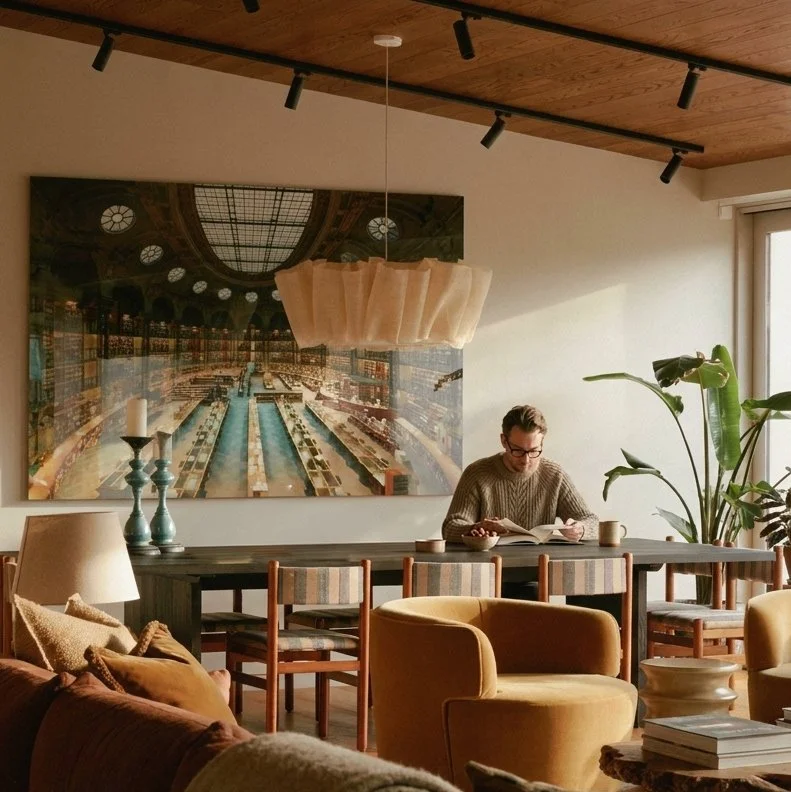
When people ask for more light in a home, they often mean something slightly different from what they say. They picture large windows, open views, a wall of glass onto the garden. But light and view are not the same thing, and confusing the two is one of the most common ways a room ends up bright and yet somehow unsatisfying.
A window, or a rooflight, is primarily there to bring light in - to carry it into the room and land it on a surface. The view is a bonus, and sometimes not even that. A rooflight set into a ceiling rarely offers a view worth having; what it offers is light from above, which is far more valuable. It's worth considering not what you will see through an opening, but what the light coming through it will fall upon once it is inside.
Light also changes through the day. The same room is one thing at breakfast and quite another at dusk - cool and flat in the morning, perhaps, then warm and golden by evening, or the reverse. A room is never lit in a single, fixed way. It is lit differently hour by hour.
So it is often less about how a room is lit than about when. A space that is bright and beautiful at three in the afternoon may be cold and grey at the hours you actually use it. Matching the light a room receives to the times of day you live in it is one of the most important, and most overlooked, parts of designing with natural light.
Light is best when it lands on a surface
Light passing straight through a room does relatively little. Light that lands on a surface - a wall, a run of joinery, a floor - is what gives a room its quality. That surface becomes a kind of canvas, catching the light and glowing with it, and it is this glow, rather than the raw amount of light, that makes a space feel calm and alive.
This is why the direction and softness of light matter as much as its quantity. Direct light can be hard-edged, flat, or bright enough to create glare the eye struggles with. Diffused light is easier to live with. By concealing or half-concealing the source - a rooflight tucked above a wall, a clerestory set high - light can be softened into something closer to dappled sunshine beneath a tree, and then allowed to wash down a vertical surface. A wall or a piece of joinery lit this way becomes the quiet focus of a room.
The best rooms often combine sources. Cool light from the north gives an even, steady quality; warmer light from the south brings life and movement, especially when it bounces off a warm material like an oak floor and carries that warmth further into the space. Balancing the two - the cool and the warm, the steady and the changing - is much of the craft of lighting a room naturally.
The shadow has its place
It is tempting to think the aim is simply to make a home as bright as possible. It is not. A room lit evenly and relentlessly, with no dark corner anywhere, is as flat and lifeless as a room that is too dark. Light means something only in relation to the shadow it emerges from.
The glowing wall glows because the rest of the room is quieter and dimmer around it. The pool of light on a table is precious precisely because it is a pool, with calmer shadow beyond its edge. Take away the shadow and you take away the very thing that made the light beautiful. There is a long tradition, in other cultures, of prizing shadow rather than banishing it - of understanding that a soft, half-lit interior, where light falls gently on a few surfaces and the corners are allowed to recede, is more restful and more beautiful than one flooded evenly throughout.
You can feel this instinct in yourself. Given the choice, most people gravitate to a table near a window, in a room that is otherwise calm and dim - not to the middle of a space lit brightly from every direction. We are drawn to the edge where light meets shade. Designing with natural light is as much about protecting the shadow as about admitting the light, so that when the light does arrive, it has something to be measured against.
Orientation changes everything
How a room is oriented determines the light it receives, and is best looked at in more detail before deciding how to open it up.
A west-facing kitchen, for instance, receives no warm morning light at all. Used at breakfast, it can feel cool and blue, coming to life only in the afternoon and evening. That is not a fault to be fixed so much as a condition to be understood and answered - often through the choice of materials and finishes that carry their own warmth, so the room feels welcoming even when the light does not supply that warmth itself. Light and material are considered together, each compensating for what the other lacks.
Rooms facing directly east, south or west also need their glazing managed so that the low, direct sun does not create glare through parts of the day. More glass is not always better. The aim is good light, evenly and comfortably distributed where it is wanted, and shade kept where it is wanted too - rather than the maximum quantity of light everywhere.
The particular value of toplight
Light from above behaves differently from light coming in through a wall. It is more even, more constant through the day, and it reaches places that side windows cannot. In a deep or enclosed plan, or a home surrounded closely by trees or neighbours, toplight is often the most effective way to bring light into the heart of a house.
One of its quietest and most rewarding uses is over a stairwell. A stair is the part of a house you move through most often, and it usually sits deep in the plan where little natural light reaches. Bringing light down through the top of a stairwell transforms the experience of moving up and down the building - the journey between floors becomes something bright and pleasant rather than a dark passage. It is a small move with a disproportionate effect on how a home feels to live in.
Why it is worth the trouble
Of all the things that determine how it feels to live in a home, natural light is among the most powerful and the least noticed. We rarely comment on good light directly - we simply feel calmer, more comfortable, more at ease in a room that has it. Getting it right is quiet, careful work, and much of it is invisible once done. It is not about flooding a home with brightness. It is about placing light and shadow so that each gives the other meaning, and the spaces you use most are lit at the hours you use them.
If you are planning a home and would like to think about how natural light could work in it, please get in touch here.