Staying in the room
Why simplicity leads to better buildings - and why it is really about attention
Notice what happens when you see a closed door with a handle on it. For a moment, your attention leaves the room you are standing in. You wonder, without meaning to, what lies on the other side. The door has quietly pulled you out of where you are and into somewhere else.
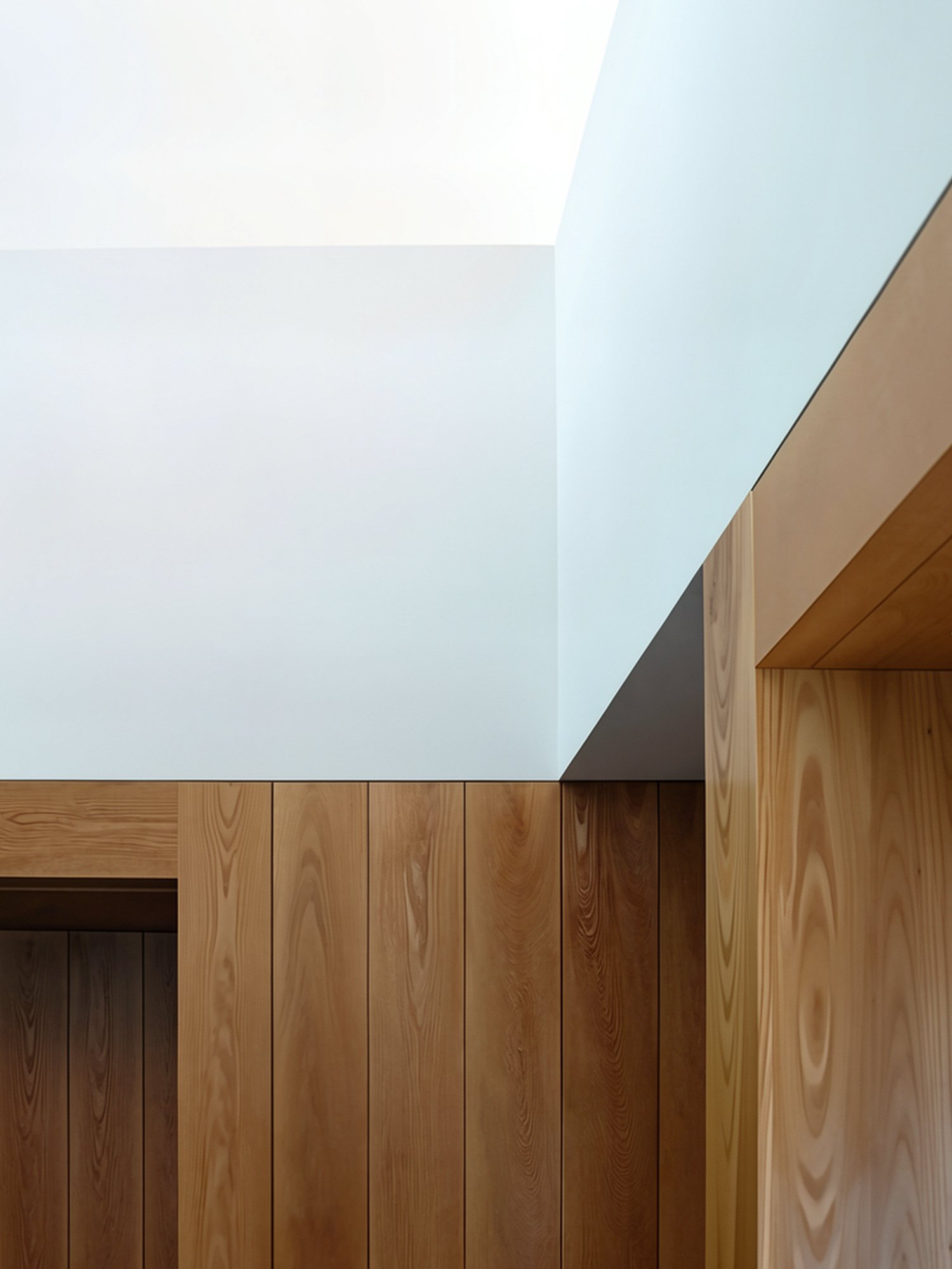
Now think of an opening instead - a space that leads your eye into light and shade, into the atmosphere of the room beyond, without announcing a threshold to be crossed. Your mind stays. You remain where you are, present in the space, rather than being sent away from it.
This, more than anything, is what simplicity in a building is really about. Not a style, not a look, not bareness for its own sake, but the control of what you see - so that nothing pulls your attention out of the moment, and the space is free to keep you in the present. A simple room is one that does not distract you from being in it.
Why that matters
Why should staying present be something to design for at all? Most modern life can feel like our attention is being pulled away from where we actually are - the screen, the next task, the low and constant tug of the thing we ought to be doing instead. We spend a great deal of our time standing in one place while our minds are somewhere else entirely. Much of what leaves us tired and unsettled is precisely this: that we are so rarely, fully, where we are.
A home is one of the very few environments we can shape to do the opposite. A space that does not tug at your attention, that lets your mind settle where your body already is, is quietly restorative in a way that is difficult to name but easy to feel. It is the difference between a room you are truly in and a room you are merely passing through in your head while standing still inside it. A home that lets you be where you are is a home that lets you rest. That is the real reward of a simple space, and it is why the difficulty of achieving one is worth the trouble.
Simplicity is not the easy option
There is a common assumption that a simple building is a cheap or an easy one - that less design has gone into it, less effort, less thought. The opposite is true. Plainness is what happens when nothing has been thought about. Simplicity is what happens when everything has been thought about, and most of it has been taken away.
Building simply is very complicated, because it requires thought to simplify to the essence while still retaining character. Every unnecessary thing in a room is a small interruption - an over-worked detail, an unresolved junction, a material that does not need to be there. Each one is a tiny version of the door with the handle, tugging at your attention. Removing them, one by one, until only the essential remains, is slow and demanding work. It is far easier to add than to take away, and far harder to know what can go without the room losing the character that makes it worth being in.
The most direct use of a thing
The buildings that move me most are the ones where this has been carried furthest - where a detail has been resolved to the point of being almost blunt. It can look so direct, so obvious, that it seems as though no one designed it at all. And yet that directness is exactly the achievement. It is a material or a junction used in the most straightforward way it could possibly be used, with nothing added to explain or decorate it.
That quality is surprisingly affecting. A thing used with complete directness has a kind of quiet confidence, and you feel it even if you could not say why. There is nothing between you and the thing itself - no flourish, no hesitation, no distraction. It is simply what it is, and it is right. Reaching that point is not a matter of holding back. It is the result of resolving something so thoroughly that it can afford to be that plain.
And a detail used this directly does not tug at you the way a fussy one does. It asks for nothing. You take it in without effort and your attention stays where it was - in the room, in the light, in the moment. Directness and presence turn out to be the same thing seen from two sides: the more directly a thing is done, the less it pulls you away from being there.
Simple to see, sound to build
There is a practical dimension to this as well, and it matters as much as the felt one. Good buildings are also practical to construct, and simplicity in design supports quality in construction. Clear ideas, resolved details and logical sequences allow a project to be crafted with care on site. When details are developed to be clearly understood and built with confidence, complexity is reduced, workmanship improves, and the finished building is robust and enduring.
So the directness that makes a detail calm to look at is the same directness that makes it sound to build. A junction resolved to its simplest form is easier to build well, less likely to fail, and less dependent on someone on site solving a problem the drawing left unanswered. The pursuit of simplicity and the pursuit of quality turn out to be the same pursuit. What is clear to the eye is usually clear to the hand that has to make it.
Better to live in, over years
A building designed this way does not always make the strongest first impression. It is not trying to. Its qualities are the kind you feel slowly, and keep feeling - the calm of a room that does not compete for your attention, the ease of a space that lets you simply be in it, the quiet rightness of things used directly and well. These are not qualities that impress in a photograph. They are qualities you live with, day after day and over years.
That is why simplicity leads to better buildings. Not because less is fashionable, but because a space that keeps you present, that is built soundly because it is built clearly, and that asks nothing of you but to be in it, is a space that goes on giving something back for as long as you live in it. Much of the work of getting there is invisible in the finished result - which is, in the end, the whole point. What remains, once everything unnecessary has been removed, is free to speak.
If you are planning a home and value this kind of quiet, considered simplicity, please get in touch here.