Two kinds of calm
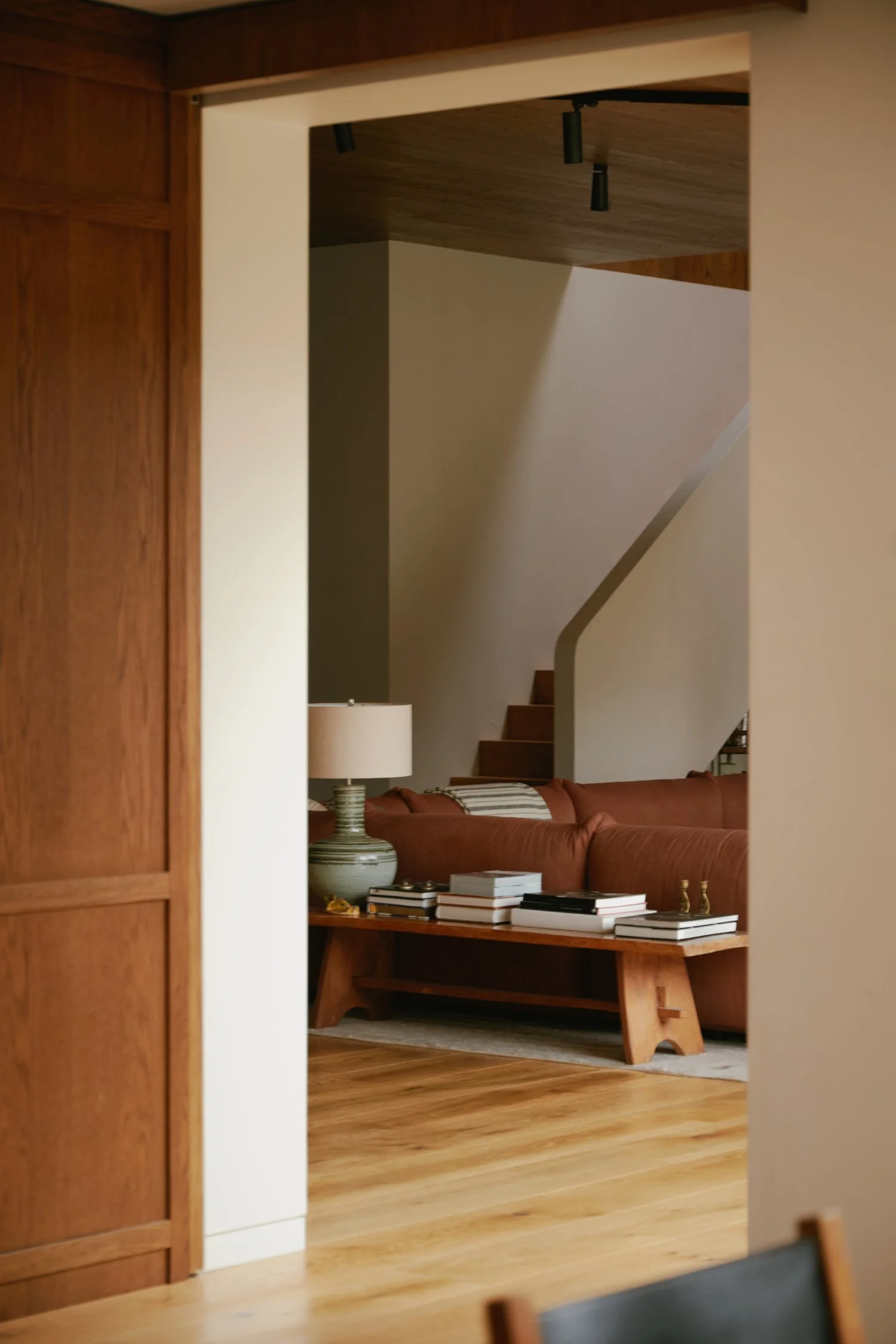
Almost every project begins with the same word. Clean. Or minimal, or uncluttered, or calm. It is the most common thing a client asks for, and one of the most misunderstood. When someone says they want a minimal room, they rarely mean they want fewer things in their life. They mean they want to feel calm when they walk into it. Those are not the same request, and it is worth knowing which one you are making before the first wall goes up, because they lead to almost opposite ways of building.
Many clients arrive slightly afraid of the first kind. They have seen the pristine white interior and admired it, but they cannot imagine living in it, and they say so plainly: they do not want a cold white box. That is a reasonable fear, but there is another way to arrive at calm, one that welcomes the evidence of a life rather than banishing it. But to choose it well, it helps first to understand exactly what the white box is.
The white box
The minimal white room, done properly, is not the absence of things. It is the concealment of them. Its serenity is real, but it is manufactured, and manufactured at considerable expense. The bare surface you admire is an achievement of hidden storage: flush cabinetry with no handles, seamless panels, joints detailed so precisely that they vanish. The ordinary clutter of a life, the chargers and the paperwork and the things you will get to later, has not gone anywhere. It has been engineered out of sight, behind a beautiful and very costly wall. What reads to the eye as less is in fact a great deal of concealed joinery. The emptiness is the most expensive thing on the drawing.
And it keeps costing after you move in, in a currency that is easy to overlook at the briefing stage. A white box has to be maintained, not occasionally but continuously. One coat left over a chair, one stack of post on the counter, one child's drawing taped to the fridge, and the spell breaks, because the whole effect depends on nothing being out of place. The stillness is genuine. It simply asks for vigilance in return, every day. For some people that trade is worth it, and this is not meant to talk anyone out of it. But it should be entered into knowing what it is: not a room with less in it, but a room that hides what is in it, and asks you to keep hiding it.
The room that holds a life
The other approach does not hide the stuff of a life. It composes with it. Here the material is allowed to show what it actually is. Concrete keeps the grain of the timber it was poured against. Brass is left to darken rather than lacquered to stay bright. Oak is chosen precisely because it will mark and mellow and carry the record of use. Nothing is detailed to disappear. The junction between two materials is declared, made into a considered line, rather than smoothed away as though the building were ashamed of being assembled. And the things you own, the books and the bowls and the objects gathered over years, are treated not as a problem to be solved but as part of the picture. Open shelves alongside closed ones. A worktop in a stone that will take a mark and be better for it. Surfaces that expect to be lived on. There is a richness to this that has nothing to do with expense. It comes from integrity - from every material being allowed to be what it is, and shown honestly, rather than wrapped and hidden away. The feeling of quality is in the revealing, not the concealing.
The framed view does the same thing outward. Where the white box wants the window to continue its emptiness, a cleanly subtracted rectangle of sky, this kind of room uses the window to reach out and capture a piece of the world with all its change and texture, and hang it on the wall like the most valuable object in the room. Which, in that moment, it is. A room built this way records a life rather than concealing one. It grows in depth as it is used, where the white box only grows harder to keep.
What still needs to disappear
It would be easy to imagine that this second kind of room simply puts everything on show. It does not, and this is the part worth understanding before choosing it. A room that lives happily with things on display still needs generous, well-planned storage for everything that does not belong on display. Not every object earns a place on the shelf. The chargers, the paperwork, the practical clutter of a household, and plenty of things that are perfectly useful but not beautiful, all still need somewhere to go, out of sight. Even well-designed products can add up to a cluttered picture when there are enough of them on show. So the lived-in room borrows the white box's discipline of concealment for the ordinary things, and saves display for the things that reward it.
This is the real skill of it, and it is not tidiness. It is a matter of judgement about what stays out and what is put away, and that judgement is something to be worked through together rather than left by chance. It is easier than it sounds, because it is mostly about giving the everyday things a proper home so that the things worth seeing are free to be seen. Done well, the result feels as though no one arranged it at all - which is, of course, the sign that it was arranged with care.
The same choice, at the scale of a city
This choice does not stop at the front door. It plays out at the scale of whole cities, and it was laid out plainly for me this summer, back in Bangkok three decades after I first knew it. Cities, like rooms, are either composed as objects or allowed to emerge, and the two produce very different places to be.
London is the white box at the scale of a city. Much of it was built in great estates, to a single pattern, by landowners who held the ground, and today conservation law holds the result in place. It is serene and coherent and controlled, and it is also a city in which you are not really permitted to record your own life on the face of your building. The variety is not missing because Londoners lack imagination. It is held back by covenant and by consent, the mess kept engineered out of view, behind the wall. It is beautiful in exactly the way the white room is beautiful, and maintained in exactly the same way, at a cost, under supervision.
Bangkok is the other thing. It grew plot by plot, each narrow frontage built and rebuilt and repainted by a different hand on its own schedule, held together by just enough shared grammar to read as a single street. The order is loose and the expression is entirely individual. And the space between is not sealed off. It is colonised. On one corner this summer I stood with my family in front of a blank gable wall, the side of a building meant for nothing, claimed by a huge mural and outlined in a rope of warm light, with scooters filling its base and the road junction itself standing in for a plaza. Nobody had designed that as a place to gather. It had simply become one. That is the leftover space where life happens without being told to.
It is not a pure or a tidy example, and I would not pretend it is. Bangkok has had things imposed on it too. The twentieth-century city of roads was dropped onto an older city of water, rapidly and without much ceremony, an imposition rather than an extension of what was there. But the striking thing, the thing I keep returning to, is what the city did with the imposition. It absorbed it. Life pooled in the gaps the grid never reached, and the slack closed back over the plan. The city kept turning whatever was dropped on it back into lived-in space. That is the deepest version of the same domestic choice. Not order against chaos, with a winner declared, but the difference between a place that must be kept perfect and hidden, and a place that is allowed to hold the evidence of everything that has happened to it.
Which calm are you chasing?
So when a client asks for calm, the response is another question, because there is more than one kind and they are not interchangeable. There is the calm that has to be maintained in secret, kept flawless and kept concealed, which rewards you with a genuine stillness in exchange for daily vigilance. And there is the calm that can live in the open, that asks you instead for a little judgement, guided along the way, and gives you back a room, or a street, or a whole city, that carries the record of a life rather than erasing it.
Neither is the wrong answer. But if the thought of the white box has ever made you hesitate, it is worth knowing that the other kind of calm is not a compromise. It is a room built to be lived in, and it is often the more welcoming, and the more forgiving, of the two. It is only worth being sure, before anything is built, which kind of calm you are actually chasing.
If you are planning a home and would like to think about which kind of calm suits the way you live, please get in touch here.